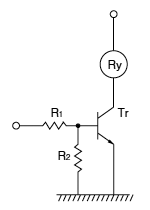
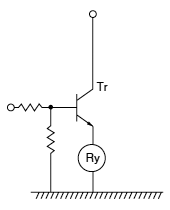
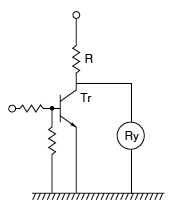
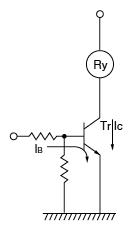
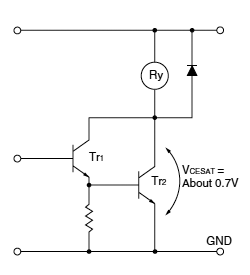
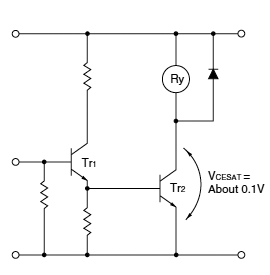
If the relay is transistor driven, we recommend using the relay on the collector side.
The voltage impressed on the relay is always full rated coil voltage, and in the OFF time, the voltage is completely zero for avoidance of trouble in use.
![]() (Good) | ![]() (Care) | ![]() (Care) |
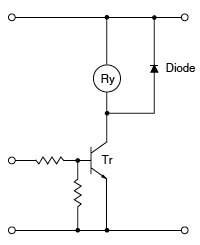
If the coil current is suddenly interrupted, a sudden high voltage pulse is developed in the coil. If this voltage exceeds the breakdown voltage of the transistor, the transistor will be degraded, and this will lead to damage. It is absolutely necessary to connect a diode in the circuit as a means of preventing damage from the counter emf. As suitable ratings for this diode, the current should be equivalent to the average rectified current to the coil, and the reverse blocking voltage should be about 3 times the value of the power source voltage. Connection of a diode is an excellent way to prevent voltage surges, but there will be a considerable time delay when the relay is open. If you need to reduce this time delay you can connect between the transistor's collector and emitter a Zener diode that will make the Zener voltage somewhat higher than the supply voltage.

Take care of "Area of Safe Operation (ASO)".
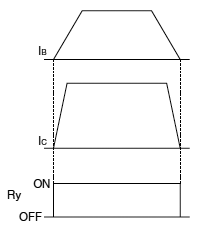
Unlike the characteristic when voltage is impressed slowly on the relay coil, this is the case where it is necessary to impress the rated voltage in a short time and also to drop the voltage in a short time.

Non-pulse signal ![]() (No Good) | Pulse signal (square wave) ![]() (Good) |
When the input signal does not produce a snap action, ordinarily a Schmitt trigger circuit is used to produce safe snap action.
Characteristic Points

This circuit is a trap into which it is easy to fall when dealing with high circuit technology. This does not mean that it is immediately connected to the defect, but it is linked to troubles that occur after long periods of use and with many units in operation.
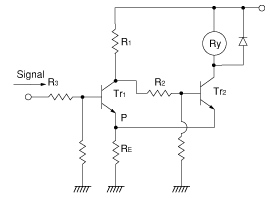
![]() (No good) Due to excessive consumption of power, | ![]() | ![]() (Good) Tr2 conducts completely. |
In switching applications where a semiconductor (transistor, UJT, etc.) is connected to the coil, a residual voltage is retained at the relay coil which may cause incomplete restoration and faulty operation. By using DC coils, there may be a danger of incomplete restoration, and a reduction in the contact pressure and the vibration resistance.
This is because the release voltage is 10% or more of the rated voltage, a low value compared to that for AC coil, and also there is a tendency to increase the life by lowering the release voltage.
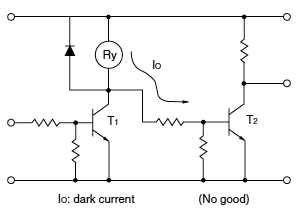
When the signal from the transistor's collector is taken and used to drive another circuit as shown in the figure on the right, a minute dark current flows to the relay even if the transistor is off. This may cause the problems described above.

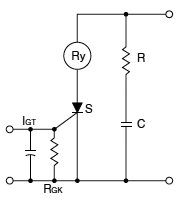
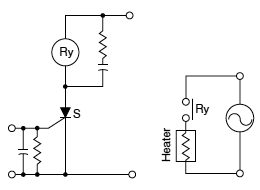
For SCR drive, it is necessary to take particular care with regard to gate sensitivity and erroneous operation due to noise.

When the relay contacts close simultaneously with an AC single phase power source, because the electrical life of the contacts suffers extreme shortening, care is necessary.

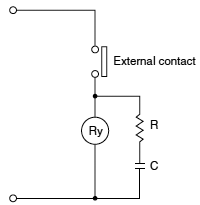
Relays for PC board use have high sensitivity and high speed response characteristics, and because they respond sufficiently to chattering and bouncing, it is necessary to take care in their drive.
When the frequency of use is low, with the delay in response time caused by a condenser, it is possible to absorb the chattering and bouncing.
(However, it is not possible to use only a condenser. A resistor should also be used with the condenser. )

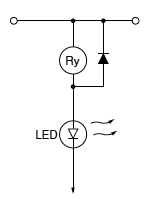
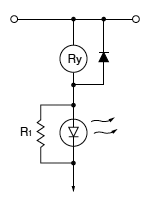
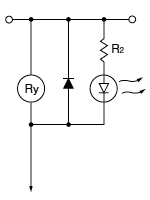
1)In series with relay ![]() Power consumption: | 2)R in parallel with LED ![]() Power consumption: | 3)In parallel connection with relay ![]() Power consumption: |
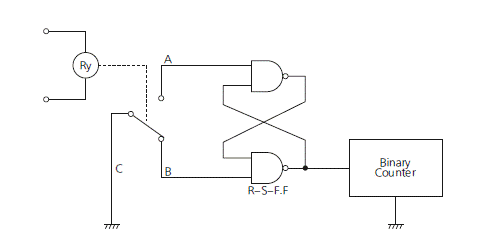
Even though a chatterless characteristic is a feature of relays, this is to the fullest extent a chatterless electrical circuit, much the same as a mercury relay. To meet the requirement for such circuits as the input to a binary counter, there is an electronic chatterless method in which chattering is absolutely not permissible. Even if chattering develops on one side, either the N.O. side contacts or the N.C. side contacts, the flip flop does not reverse, and the counter circuit can be fed pulsed without a miss. (However, bouncing from the N.O. side to N.C. side must be absolutely avoided.)

Notes:
When an electronic circuit using a direct drive from a triac, the electronic circuit will not be isolated from the power circuit, and because of this, troubles due to erroneous operation and damage can develop easily. The introduction of a relay drive is the most economical and most effective solution. (Photo coupler and pulse transformer circuits are complicated.)
When a zero cross switching characteristic is necessary, a solid state relay (SSR) should be used.

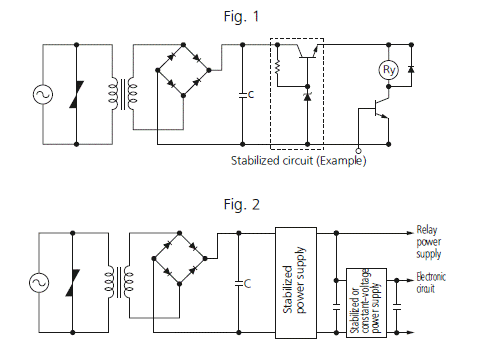
In general, electronic circuits are extremely vulnerable to such phenomena as power supply ripples and voltage fluctuations. Although relay power supplies are not as vulnerable as electronic circuits, please keep both ripples and the regulation within the specification.

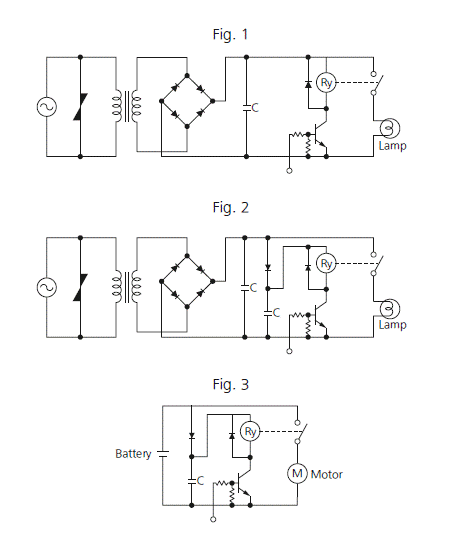
In the circuit shown in Fig. 1, rush current flows from the lamp or capacitor. The instant the contacts close, the voltage drops and the relay releases or chatters.
In this case it is necessary to raise the transformer's capacity or add a smoothing circuit.

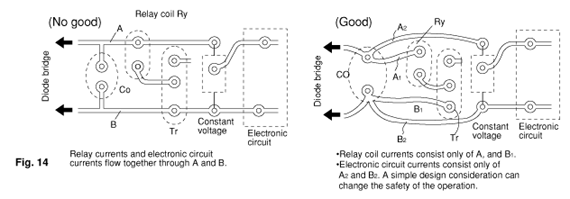
Since relays affect electronic circuits by generating noise, the following points should be noted.

The hole diameter and land are made with the hole slightly larger than the lead wire so that the component may be inserted easily. Also, when soldering, the solder will build up in an eyelet condition, increasing the mounting strength. The standard dimensions for the hole diameter and land are shown in the table below.
Standard dimensions for hole and land diameter (Unit: mm)
| Standard hole diameter | Tolerance | Land diameter |
|---|---|---|
| 0.8 | ±0.1 | 2.0~3.0 |
| 1.0 | ||
| 1.2 | 3.5~4.5 | |
| 1.6 |
Remarks
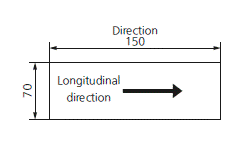
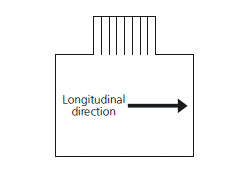
Because copperclad laminates have a longitudinal and lateral direction,the manner of punching fabrication and layout must be observed with care. The expansion and shrinkage in the longitudinal direction due to heat is 1/15 to 1/2 that in the lateral,and accordingly, after the punching fabrication, the distortion in the longitudinal direction will be 1/15 to 1/2 that of the lateral direction. The mechanical strength in the longitudinal direction is 10 to 15% greater than that in the lateral direction. Because of this difference between the longitudinal and lateral directions, when products having long configurations are to be fabricated, the lengthwise direction of the configuration should be made in the longitudinal direction, and PC boards having a connector section should be made with the connector along the longitudinal side.
Example : As shown is the drawing below, the 150 mm direction is taken as the longitudinal direction.

Also, as shown in the drawing below, when the pattern has a connector section, the direction is taken as shown by the arrow in the longitudinal direction

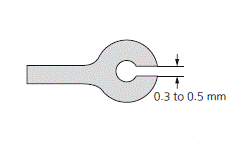
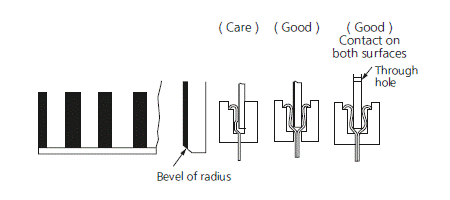
By providing a narrow slot in the circular part of the foil pattern, the slot will prevent the hole from being plugged with solder.


This data has been derived from samples of this company's products. Use this data as a reference when designing printed circuit boards.
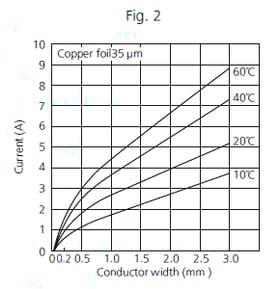
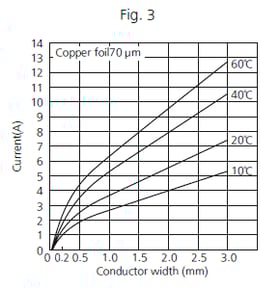
The allowable current for the conductor was determined from the safety aspect and the effect on the performance of the conductor due to the rise in saturation temperature when current is flowing. (The narrower the conductor width and the thinner the copper foil, the larger the temperature rise.) For example, too high a rise in temperature causes degradation of the characteristic and color changes of the laminate. In general, the allowable current of the conductor is determined so that the rise is temperature is less than 10°C. It is necessary to design the conductor width from this allowable conductor current.
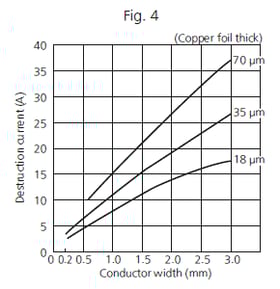
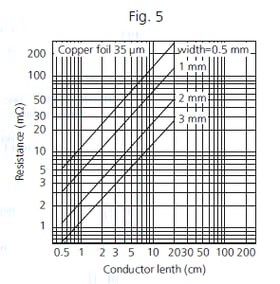
Fig. 1, Fig. 2, Fig. 3 show the relationship between the current and the conductor width for each rise in temperature for different copper foils. It is also necessary to give consideration to preventing abnormal currents from exceeding the destruction current of the conductor.
Fig. 4 shows the relationship between the conductor width and the destruction current.

![]() | ![]() | ![]() | ![]() | ![]() |
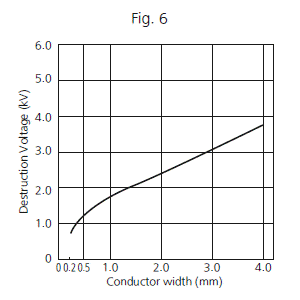
Fig. 6 shows the relationship between the spacing between conductors and the destruction voltage. This destruction voltage is not the destruction voltage of the PCB; it is the flash over voltage (insulation breakdown voltage of the space between circuits.) Coating the surface of the conductor with an insulating resin such as a solder resist increases the flash over voltage, but because of the pin holes of the solder resist, it is necessary to consider the conductor destruction voltage without the solder resist. In fact, it is necessary to add an ample safety factor when determining the spacing between conductors. Table 1 shows an example of a design for the spacing between conductors. (Taken from the JIS C5010 standards.) However, when the product is covered by the electrical products control law, UL standards or other safety standards, it is necessary to conform to the regulations.

Example of conductor spacing design
| Maximum DC and AC Voltage Between Conductors (V) | Minimum Conductor Spacing (mm) |
|---|---|
| 0 to 50 | 0.381 |
| 51 to 150 | 0.635 |
| 151 to 300 | 1.27 |
| 301 to 500 | 2.54 |
| 500 or more | Calculated at 0.00508 mm/V |
Technical Inquiries, Purchase Support & Additional Assistance
Contact UsTechnical Inquiries, Purchase Support & Additional Assistance
Contact Us* The term 'specific products' refers to tactile switches (light-touch switches), detector switches, push switches, encoders, rotary volume controls, position sensors, and touch panels.