

MENU
Eliminate High-Speed Measurement Noise & Cabling Issues

High-speed sampling at 8 Gbps drastically improves measurement resolution.
With ±7 kV electrical isolation, AOC reduces common-mode noise and ensures equipment safety.
We have prepared documents summarizing features and specs. Use them as a first step to streamline evaluation and comparison.
_LP%E7%94%BB%E5%83%8F%E3%82%B5%E3%82%A4%E3%82%BA_EMCBD-2.png)
Conventional isolation devices can’t fully escape these trade-offs. In fact, many hardware designers say they “can’t find parts that deliver higher speed and smaller size at the same time.”
Panasonic Industry’s Active Optical Connector converts electrical signals to light inside the plug, achieving 8 Gbps high-speed, long-distance transmission and ±7 kV electrical isolation simultaneously—all while staying about the size of a fingertip. Compared with conventional optical transceivers (SFP), it reduces PCB footprint by up to 85% and provides both high-speed transmission and electrical isolation in a single device.
_LP%E7%94%BB%E5%83%8F%E3%82%B5%E3%82%A4%E3%82%BA_EMCBD-1-868x440%20Problem01.png)
Background: As sampling frequencies rise, Gbps-class real-time transmission between measurement boards becomes essential.
Issue: With existing isolation devices, long wiring runs or multi-device chains shrink the eye opening and increase crosstalk and jitter, forcing re-measurement or equalization adjustments, delaying the schedule.
Result: Late in evaluation, teams face rework when “target bandwidth isn’t achieved” or “waveform distortion won’t converge,” keeping engineering workloads high.
_LP%E7%94%BB%E5%83%8F%E3%82%B5%E3%82%A4%E3%82%BA_EMCBD-4-868x440%20Problem02.png)
Background: In applications such as EV inverters and power analyzers, target voltages range from hundreds of volts to several kilovolts.
Issue: CMTI countermeasures are difficult; placing multiple digital isolators increases board area and part count.
Result: Thermal design, EMC testing, and safety documentation grow complex, creating a cycle of “test failure → design change.”
_LP%E7%94%BB%E5%83%8F%E3%82%B5%E3%82%A4%E3%82%BA_EMCBD-3-868x440%20Problem03.png)
Background: Multi-channel measurement downsize I/O counts while enclosures are expected to shrink to “desktop size.”
Issue: Impedance control, shielding, and inter-layer vias for high-speed differential pairs complicate layouts. Existing isolation devices occupy large areas and limit placement freedom for heat-generating parts.
Result: Layout trial-and-error and re-routing become the norm, eating into development time.
_LP%E7%94%BB%E5%83%8F%E3%82%B5%E3%82%A4%E3%82%BA_EMCBD-6-868x440%20Problem04.png)
Background: Isolation is required between high-voltage measurement circuits and low-voltage signal-processing circuits.
Issue: To protect equipment from leakage current, teams must select high-grade isolation devices and often cascade them, which increases board area and part count.
Result: Repeated isolation-endurance evaluations are needed, increasing effort for design verification and safety measures.

A two-channel integrated module transmits high-speed differential signals from 20 Mbps to 8 Gbps with minimal loss. Improved eye openings cut down on re-measurement and equalizer re-tuning, raising evaluation throughput.
Insulation withstand voltage is ±7 kV. Even in inverter and high-voltage power measurement environments, the high-voltage measurement system and signal processing system are safely isolated, improving pass rates for EMC and safety compliance tests.
_LP%E7%94%BB%E5%83%8F%E3%82%B5%E3%82%A4%E3%82%BA_EMCBD-7-868x440%20Function01.png)
Supports differential SLVS-200 inputs, covering everything from low-speed control to Gbps-class streams with a single device, offering flexibility for future test updates and standard revisions.
Optional: Up to 10 Gbps/channel.
_LP%E7%94%BB%E5%83%8F%E3%82%B5%E3%82%A4%E3%82%BA_EMCBD-12-868x440%20Function02.png)
Optical fiber transmission achieves insulation withstand voltage ±7 kV. Maintain required clearance in inverter measurements and high-voltage applications while minimizing the number of isolation devices.
_LP%E7%94%BB%E5%83%8F%E3%82%B5%E3%82%A4%E3%82%BA_EMCBD-9-868x440%20Function03.png)
Up to 85% footprint reduction vs. SFP-class optics. This simplifies space provisioning even on I/O-dense boards, with improved freedom for cooling paths and routing.
_LP%E7%94%BB%E5%83%8F%E3%82%B5%E3%82%A4%E3%82%BA_EMCBD-15-868x440%20Function04.png)
By completing optical conversion in the plug, AOC minimizes phase shift in real-time control and synchronous measurement—ideal for high-speed servo and vision inspection.
_LP%E7%94%BB%E5%83%8F%E3%82%B5%E3%82%A4%E3%82%BA_EMCBD-16-868x440%20Function04%20(1).png)
Because the cable is fully decoupled from noise sources, it maintains reliable transmission even under high-frequency noise or lightning surges, helping you clear EMI/EMS tests with a comfortable margin.
_LP%E7%94%BB%E5%83%8F%E3%82%B5%E3%82%A4%E3%82%BA_EMCBD-12-868x440%20Function04%20(1).png)
Match the optical fiber length to the distance between measurement points. When equipment layouts change, you can adapt without PCB rework. (For other lengths, please contact us.)
_LP%E7%94%BB%E5%83%8F%E3%82%B5%E3%82%A4%E3%82%BA_EMCBD-5-868x440Customers%20Voice01.png)
Challenges & background
Solution with AOC
_LP%E7%94%BB%E5%83%8F%E3%82%B5%E3%82%A4%E3%82%BA_EMCBD-5-868x440Customers%20Voice02.png)
Challenges & background
Solution with AOC
_LP%E7%94%BB%E5%83%8F%E3%82%B5%E3%82%A4%E3%82%BA_EMCBD-6-868x440Customers%20Voice03.png)
Challenges & background
Solution with AOC
_LP%E7%94%BB%E5%83%8F%E3%82%B5%E3%82%A4%E3%82%BA_EMCBD-7-868x440Customers%20Support01.png)
Dedicated optical-communication FAEs work alongside each project, advising on everything from requirements capture to part selection and circuit-design best practices.
_LP%E7%94%BB%E5%83%8F%E3%82%B5%E3%82%A4%E3%82%BA_EMCBD-8-868x440Customers%20Support02.png)
We provide or loan the hardware and documentation needed for evaluation and verification, accelerating design-in.
_LP%E7%94%BB%E5%83%8F%E3%82%B5%E3%82%A4%E3%82%BA_EMCBD-9-868x440Customers%20Support03.png)
Panasonic Industry’s global sites and distributor network handle material supply and technical responses.
_LP%E7%94%BB%E5%83%8F%E3%82%B5%E3%82%A4%E3%82%BA_EMCBD-12-780x446%20%E5%95%86%E5%93%81%E3%83%A9%E3%82%A4%E3%83%B3%E3%82%A2%E3%83%83%E3%83%97.png)
Supports 20 Mbps to 8 Gbps, with plug/receptacle options and an integrated cable. Built-in electrical-to-optical conversion for easy handling.
Two unidirectional channels supporting up to 16 Gbps (8 Gbps/ch)—ideal for high-throughput applications.
_LP%E7%94%BB%E5%83%8F%E3%82%B5%E3%82%A4%E3%82%BA_EMCBD-14-780x446%20%E5%95%86%E5%93%81%E3%83%A9%E3%82%A4%E3%83%B3%E3%82%A2%E3%83%83%E3%83%97.png)
Connects directly to standard LC optical fiber connectors—ideal for inter-equipment communication.
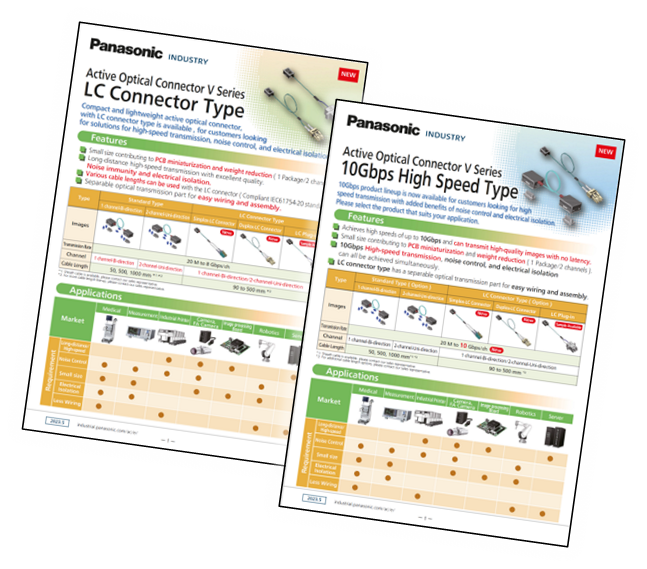
We have prepared documents summarizing features and specs. Use them as a first step to streamline evaluation and comparison.


Contact
Get expert advice on product selection and technical evaluation.
Looking to:
・confirm detailed technical requirements for deployment,
・get a connector configuration tailored to your product, or
・request evaluation samples and reference materials?
Our technical sales team and Field Application Engineers (FAEs) will review your requirements to recommend the optimal configuration for your application and deployment environment.

 Area/Country
